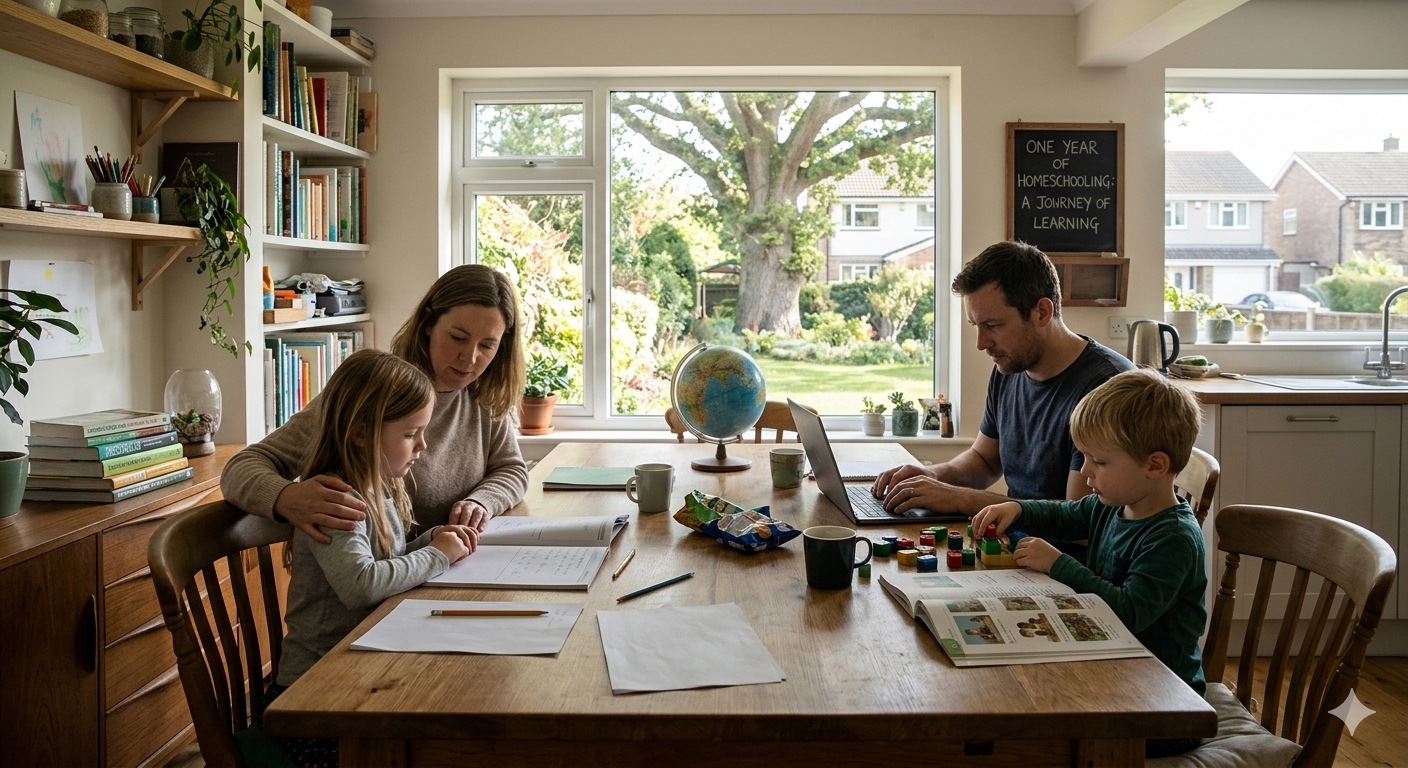
It started with a Tuesday morning meltdown.
My daughter, Nora, was eight years old, sitting at the kitchen table with tears streaming down her face over a math worksheet she’d already done three times. The school kept sending the same packet home. She wasn’t struggling — she was bored. And I remember thinking: we could do this better at home.
So we did.
What followed was one of the most rewarding, exhausting, humbling, and eye-opening years of our family’s life. We stumbled through curriculum choices, schedule disasters, and a few spectacular arguments about whether documentaries count as school. By June, we’d found our footing — but we’d also wished, more than once, that someone had given us an honest roadmap from the start.
Here’s what we wish we’d known.
The First Month Will Feel Like Failure
Nothing prepares you for “deschooling” — the period when kids decompress from traditional school before they’re ready to learn differently. Experts often suggest one month of decompression for every year a child spent in school. For Nora, that meant weeks of what looked, from the outside, like doing absolutely nothing.
She read graphic novels. She built elaborate marble runs. She watched cooking shows and asked to make pasta from scratch.
I panicked. I bought more workbooks. I made a color-coded schedule with time blocks and laminated it.
She ignored it completely.
What I eventually understood is that deschooling isn’t wasted time — it’s essential time. Her brain was recalibrating, rediscovering what curiosity felt like without grades attached to it. The panic was mine, not hers.
What we wish we knew: Trust the slow start. The learning will come. Give it space to arrive naturally.
You Don’t Need to Recreate School at Home
This was my biggest mistake in month two. I set up a “classroom corner,” established a bell schedule, and even printed attendance sheets. I was essentially running a tiny, worse version of the school we’d just left.
Homeschooling works best when it looks nothing like a classroom. Lessons happen at the kitchen counter, on hiking trails, in the car between errands. A conversation about why bread rises can teach more chemistry than a worksheet ever did. A trip to the farmers’ market becomes economics, biology, and social skills all at once.
Once I let go of the school template, everything loosened up. Nora started asking questions I didn’t know how to answer — and that became the curriculum.
What we wish we knew: Your home is not a school building. Stop trying to make it one.
Your Child Will Push Every Boundary — Because They Can
At school, the teacher’s authority is clear. At home, Nora quickly figured out that I was both teacher and mom, and she used that masterfully. Every “I don’t want to” came loaded with emotional weight that a classroom teacher simply wouldn’t have to navigate.
We had to establish completely new relational boundaries. I learned to separate “mom time” from “learning time” with small rituals — a specific chair, a cup of tea, a phrase like “okay, let’s shift gears.” It felt artificial at first. Eventually, it became sacred.
What we wish we knew: The parent-teacher dynamic is genuinely hard. Build rituals that signal the transition between roles.
Community Is Everything — and It Takes Effort to Build
The loneliness surprised me more than it did Nora.
She found her people quickly through a local homeschool co-op, a theater group, and weekly park meetups. I was the one who felt isolated, suddenly cut off from the casual camaraderie of school drop-off, teacher emails, and shared classroom experiences.
Homeschooling requires intentional community building. It doesn’t come built-in.
What we wish we knew: Find your tribe before you start, not after you’re drowning.
It Will Change Your Family — In Ways You Can’t Predict
By spring, something had shifted quietly between all of us. Nora was more confident, more curious, and far more willing to say I don’t know, let’s find out. My husband and I talked about ideas over dinner again. We slowed down.
Homeschooling didn’t just change how Nora learned. It changed how we lived.
Was it perfect? Absolutely not. There were days I counted the minutes to bedtime. But there were also afternoons we spent reading aloud for two hours straight, completely forgetting that it was “school.”
If you’re considering it — go in with open eyes, flexible plans, and a very good sense of humor. It’s harder than you think, and better than you can imagine.