Conventional real estate wisdom can feel completely discouraging for single-income households. The prevailing narrative on most financial forums suggests that without two corporate salaries, purchasing a comfortable family home in a desirable school district is virtually impossible.
When we made the choice to transition to a single income following the arrival of our second child, we were repeatedly told we would be stuck renting indefinitely. Yet, a few months ago, we officially closed on a three-bedroom suburban house. It didn’t take a stroke of luck, an inheritance, or a lottery win. Instead, it was the result of two years of meticulous, deliberate financial planning.
Here is the exact, unfiltered financial strategy we used to turn that goal into a reality.
Setting the Baseline
To see how this was achievable, it helps to look directly at our starting point. Our household includes two adults, a four-year-old, and a one-year-old. Our entire budget relies on a single gross annual income of $84,000, which leaves us with roughly $5,400 in net monthly take-home pay after accounting for taxes, health insurance, and modest retirement contributions. Our objective was to find a safe, structurally sound three-bedroom house located within a quality elementary school district.
Testing Our Budget with an “Artificial Mortgage”
Dropping from two incomes down to one significantly altered our monthly cash flow. To verify whether homeownership was a realistic path for us, we spent a year and a half practicing a strategy we called an “artificial mortgage.”
While our actual rent at the time was $1,500, we estimated that our future mortgage, property taxes, and homeowners insurance would total closer to $2,400 a month.
Every single month for a year and a half, we immediately transferred that $900 difference into a high-yield savings account the moment our paycheck landed. By combining this forced saving habit with the money we saved from eliminating paid childcare—and adding our annual tax refunds—we successfully accumulated $24,000 to cover our down payment and closing costs.
Consistently living on this restricted budget while renting gave us the confidence that we could comfortably manage a higher monthly housing payment without stretching ourselves too thin.
Mapping Out Our Monthly Expenses
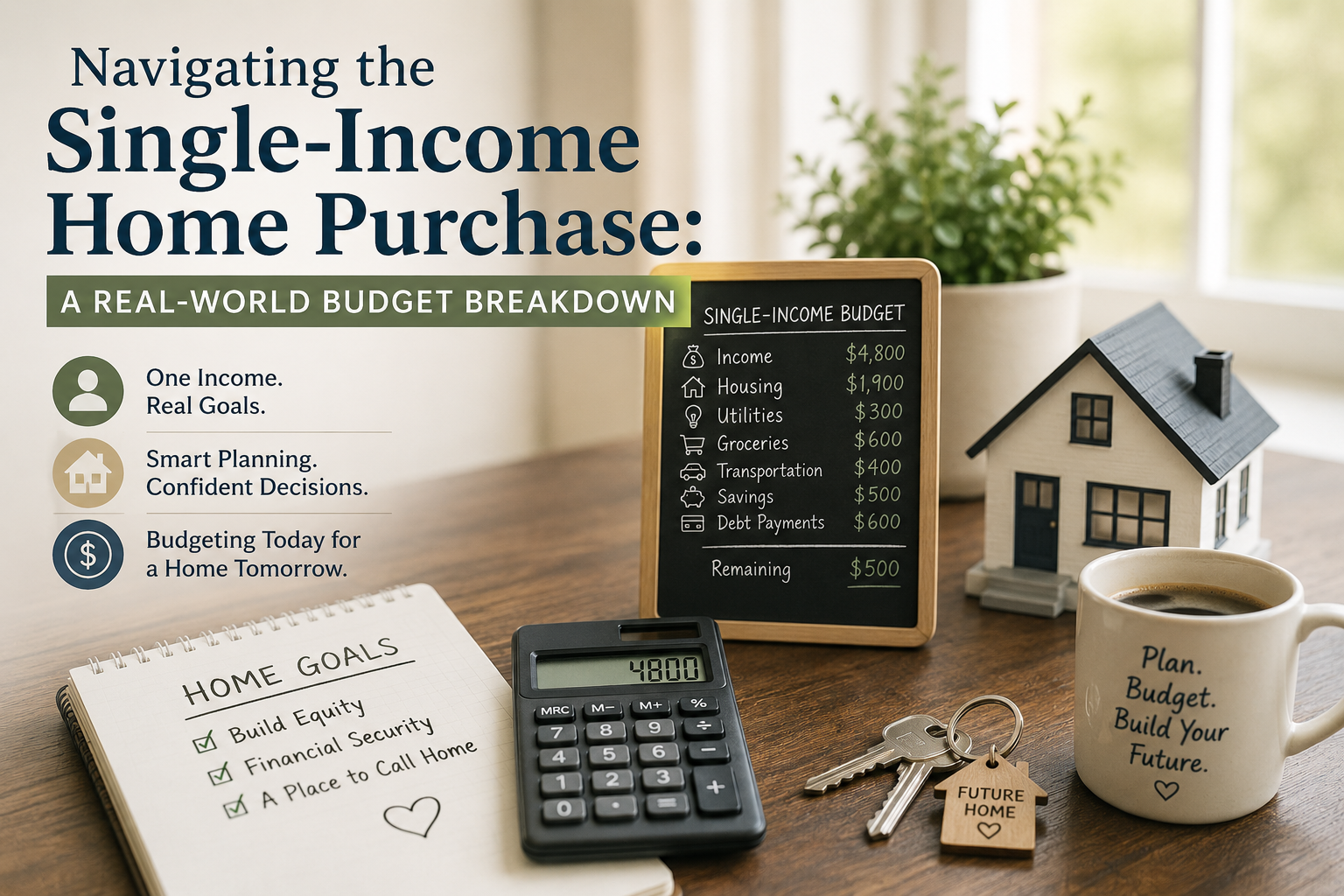
Managing a family of four on $5,400 a month requires tracking every single dollar. Our largest fixed expense was rent and utilities, which demanded $1,750 monthly just to keep our living space heated and functioning. We set aside $700 each month for groceries and household necessities, relying heavily on buying in bulk, intentional meal planning, and ensuring we eliminated food waste entirely.
To improve our debt-to-income ratio for future mortgage approval, we dedicated $450 a month toward aggressively paying down our outstanding student loans and car payments. Essential protections, including auto and life insurance policies, cost $250 a month, while gasoline, diapers, and secondhand children’s clothes from consignment shops took up another $400.
Beyond our dedicated $900 monthly housing savings transfer, we maintained a consistent buffer of $950 to cover medical copays, birthday gifts, and unexpected minor emergencies.
Adjusting Expectations for the Housing Market
Once we hit our $24,000 savings goal, we met with a local mortgage broker. Thanks to our focus on minimizing non-housing debts, our debt-to-income ratio sat at a favorable 28%, earning us a pre-approval for a $320,000 loan.
However, looking closely at the math, borrowing the full $320,000 at current interest rates would have driven our monthly payment past $2,600, leaving us with far too little breathing room. Because we refused to be “house poor,” we deliberately capped our maximum purchase price at $265,000.
Finding a suitable home at this price point required making specific, practical compromises. First, we expanded our search radius 25 minutes further out into the suburbs, bypassing the trendier, highly competitive neighborhoods. Second, we skipped properties that featured expensive, modern cosmetic renovations, focusing instead on structurally sound homes that just needed fresh paint and a bit of hard work to look their best.
The Closing Financial Details
We eventually found a split-level house listed at $260,000 that had been on the market for 40 days. Because it required some cosmetic updating, we were able to negotiate the final price down to $258,000 without getting caught in a bidding war.
By utilizing a 3.5% FHA loan, our required down payment came out to $9,030. Closing costs and prepaid items added $8,200 to the transaction, bringing our total out-of-pocket cash to $17,230. This left us with a critical $6,770 cushion from our savings to serve as an emergency fund.
Our current monthly housing expenses total $2,130. This baseline payment is divided into $1,540 for the loan principal and interest, $310 for local property taxes, $115 for our homeowners insurance policy, and $165 for private mortgage insurance.
The Reality of the Single-Income Journey
At $2,130 each month, housing takes up about 39% of our net monthly income. While this is higher than the standard financial recommendation of keeping housing costs under 30%, it remains entirely manageable for us because we currently have zero childcare expenses.
Our lifestyle requires trade-offs: we skip expensive vacations, our furniture is largely secondhand, and a night out usually means ordering takeout on the living room floor after the kids are asleep. However, every single payment we make builds equity in a long-term asset that belongs to our family. Successfully buying a home on a single income with children isn’t about uncovering a hidden shortcut—it’s about committing to practical compromises and staying accountable to your numbers.