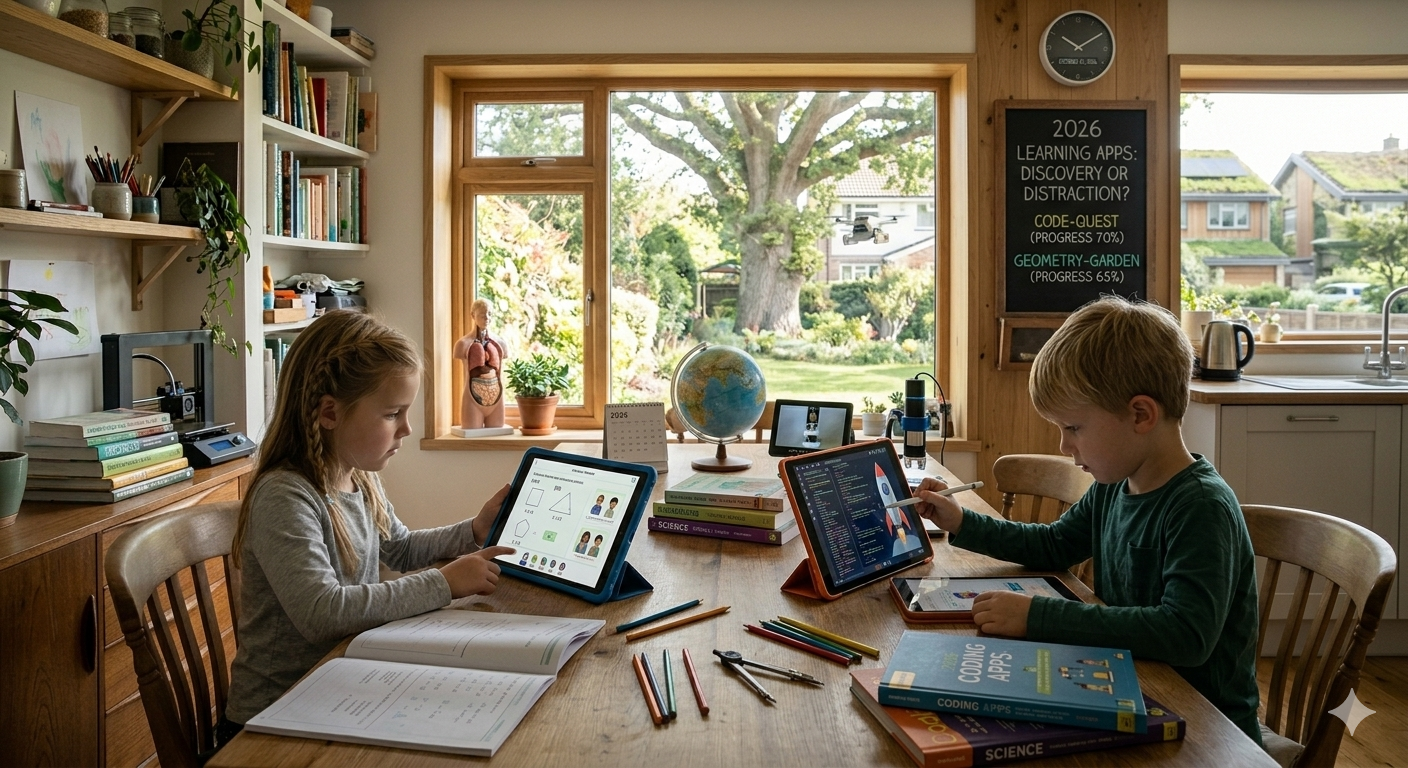
The year 2026 has ushered in a new era of digital learning. The educational landscape, once a chaotic marketplace of “edutainment” apps, has consolidated around a new standard. Today’s parents are no longer content with apps that are mere digital pacifiers. They demand tools that deliver verifiable, personalized, and engaging educational experiences. This shift is driven by advances in artificial intelligence and a deeper understanding of digital pedagogy.
The defining characteristic of successful educational apps in 2026 is their commitment to “What Actually Teaches.” This is not a return to dull rote memorization. Instead, it’s a sophisticated blend of learning and play. The modern standard of educational apps is built on several key pillars.
The first is genuine personalization. AI algorithms now analyze a child’s interaction with the app in real-time. If a child is struggling with fractions, the app doesn’t just lower the difficulty. It identifies the underlying concept they’ve missed—perhaps equivalent fractions—and provides targeted, conceptual guidance. This creates an Adaptive Learning path unique to each child, ensuring they are always challenged but never overwhelmed.
The second pillar is active learning over passive consumption. The most effective apps turn the screen into a workshop, not just a stage. A history app might not simply play a video about the ancient Egyptians; it will encourage a child to use their tablet to create a virtual tomb and decipher hieroglyphs, using Augmented Reality to bring the pyramid into their living room. A math app might integrate the physical world, asking a child to use their camera to find and measure shapes in their own environment.
The third pillar is tangible progress. Apps must offer measurable skill acquisition. This isn’t just about unlocking “levels” in a game. It’s about earning certifiable badges that map to real-world academic benchmarks. Parents receive sophisticated, clear data that goes far beyond “Your child played for 30 minutes.” It will state: “Your child has mastered the concepts of division and is now learning about decimal placement. Here is a sample problem they solved today.”
In contrast, the market for apps that “Just Entertain” is shrinking. These are the apps that parents from the early 20s remember—bright, loud, and primarily design to hold a child’s attention. Their “educational” aspect is often a thin veneer. An app that lets a child color a digital animal, for instance, is entertaining, but its claim of teaching “biology” is dubious. Apps that feature constant pop-up rewards, flashing lights, and in-app purchase offers are increasingly viewed as exploitative. In 2026, the absence of intrusive marketing is a hallmark of a quality educational tool.
The ideal app for 2026, therefore, is one that strikes a balance. It must be as engaging and fun as any popular game, but its primary purpose—and its primary loop—is learning. Consider an advanced coding app. A child isn’t just dragging blocks around; they are using a simplified, visual-based syntax to program their own virtual drone, learning principles of logic, loops, and conditional statements. The app may have a multiplayer component, but it’s collaborative, not just competitive, where groups of kids have to code together to solve a shared problem.
For parents, navigating this new world requires vigilance. The best apps will be transparent. They will explicitly state their learning objectives. They will integrate seamlessly with parent-monitoring tools, providing not just usage time but conceptual progress. They will be recommended by educational psychologists and academic institutions.
The educational app market in 2026 is a mature, sophisticated ecosystem. The tools available to our children have never been more powerful or more precisely designed. But the oldest rule of technology still applies: it is not the tool itself, but how we use it, that matters. The best apps do not replace teachers or parents; they are incredible partners, providing a personalized, adaptive, and truly educational journey that has left the realm of simple entertainment far behind.