For years, the narrative surrounding children and digital devices has been defined by a single, ominous word: “limits.” Parents have been conditioned to view screens as a modern-day Pandora’s box, where every minute spent in front of a tablet is a minute of cognitive development lost. However, as we move through 2026, the scientific community is shifting away from simple hourly tallies toward a more sophisticated understanding of the digital experience.
The latest research suggests that the “how” and “what” of screen time are far more influential on a child’s well-being than the “how long.”
The Death of the “Passive vs. Active” Binary
Earlier research often categorized screen use as either “passive” (watching videos) or “active” (playing games). New longitudinal studies have found this distinction is too blunt. Instead, researchers now look at cognitive demand and social integration.
A child watching a high-quality educational program that encourages verbal participation—a concept known as “contingent interaction”—shows significantly different neurological outcomes than a child mindlessly scrolling through short-form, high-intensity video feeds. The latter is often linked to “bottom-up” attention shifts, which can make sustained “top-down” focus more difficult in classroom settings.
The Displacement Hypothesis
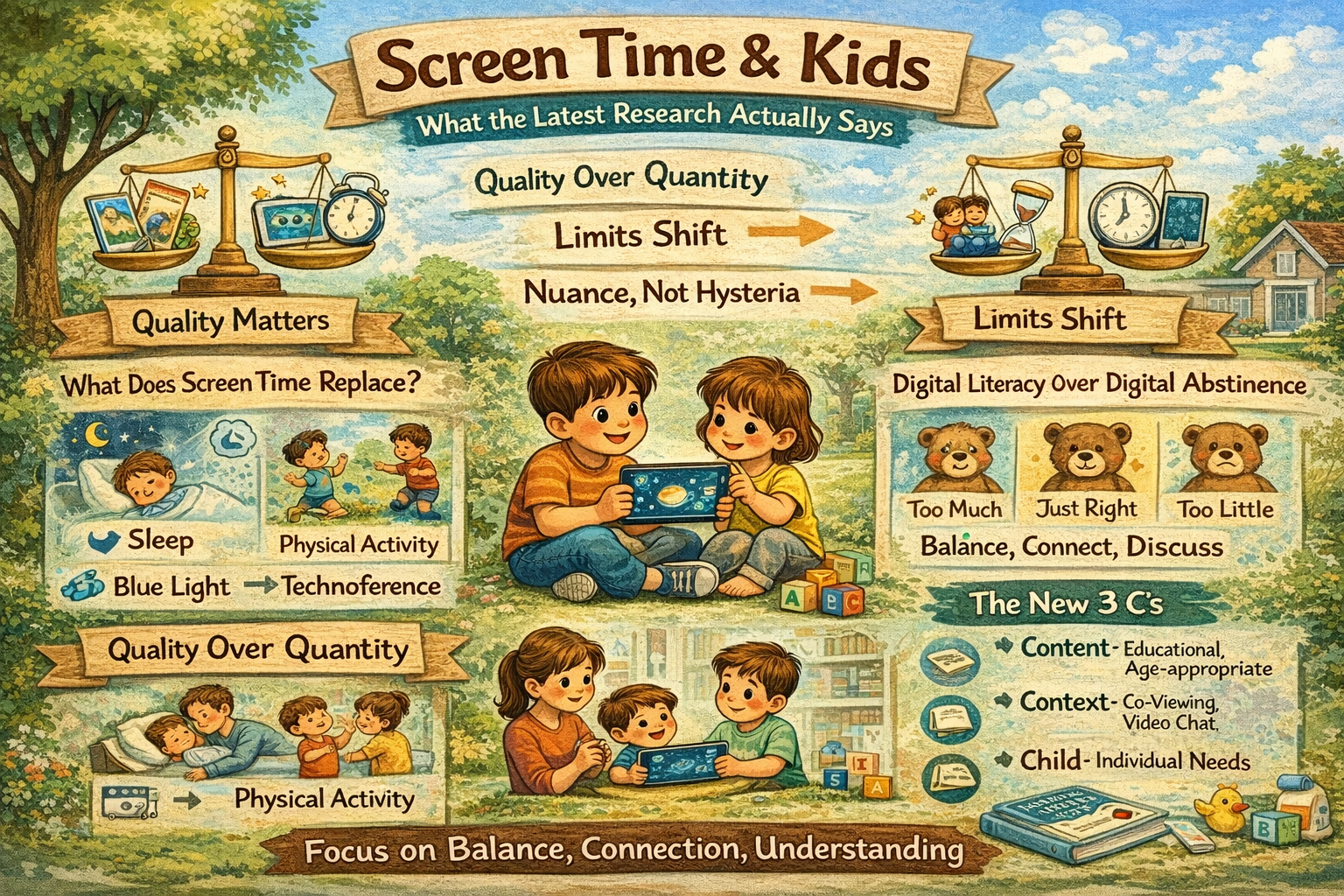
The most significant concern in contemporary pediatrics isn’t the screen itself, but what the screen displaces. This is known as the Displacement Hypothesis. The negative effects attributed to digital devices often stem from the loss of three critical pillars:
-
Sleep: Blue light exposure and the psychological stimulation of interactive media can delay melatonin production and shorten sleep duration.
-
Physical Activity: Sedentary behavior is a known risk factor for metabolic health.
-
Face-to-Face Interaction: For toddlers, the “still-face” effect—where a parent is distracted by their own phone (technoference)—can disrupt the emotional mirroring necessary for social development.
The Nuance of Connection
One of the most surprising findings in recent years involves adolescents. While heavy social media use is linked to increased anxiety in some demographics, the “Goldilocks Hypothesis” suggests that a moderate amount of digital connectivity is actually associated with better well-being than no connectivity at all. In a world where social lives are mediated by digital platforms, a “digital hermit” status can lead to social exclusion and feelings of isolation.
The research now emphasizes Digital Literacy over Digital Abstinence. Children who are taught to critically analyze the content they consume—recognizing algorithmic bias or the curated nature of social media—show higher levels of resilience against the negative mental health impacts of the internet.
Quality Over Quantity: The New Guidelines
Instead of rigid stopwatches, developmental psychologists are now advocating for the “Three C’s”:
-
Content: Is the content age-appropriate, educational, or prosocial?
-
Context: Is the screen being used to connect with a grandparent on a video call, or is it a “digital pacifier” used to quiet a tantrum?
-
Child: Every child is different. A child prone to impulsivity may struggle more with the reward loops of video games than a peer who uses the same device for digital art.
The Path Forward
The “latest research” isn’t a mandate for unrestricted access, nor is it a validation of the “screen-free” lifestyle. It is a call for intentionality. The goal for the modern parent is no longer to be a gatekeeper, but a mentor. By co-viewing content, discussing the emotions triggered by games, and ensuring that digital time does not infringe upon sleep or movement, we can help children navigate a world where the screen is not a separate entity, but a permanent fixture of reality.
Ultimately, a tablet is a tool. Whether it serves as a window to the world or a wall against it depends entirely on the framework we build around it.