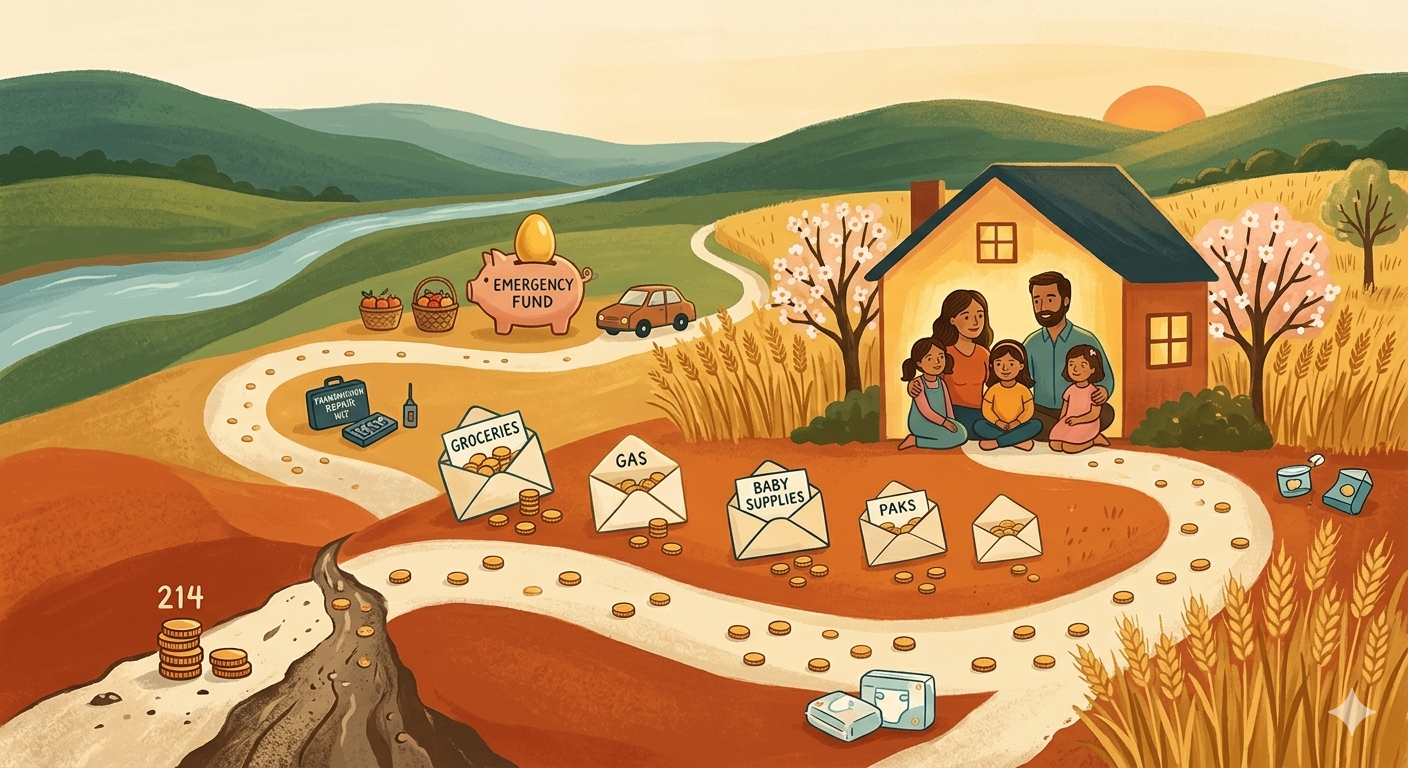
I still remember staring at our bank account the morning our third daughter, Nora, came home from the hospital.
The balance read $214.
Not $2,140. Not $21,400. Two hundred and fourteen dollars — and roughly $180 of that was earmarked for diapers we hadn’t bought yet.
My husband Marcus and I had always considered ourselves “pretty responsible” with money. We had a budget. We had a joint account. We talked about savings… a lot. But talk, as it turns out, doesn’t compound interest.
Between the unexpected costs of our second child’s speech therapy, a car transmission that gave up the ghost in October, and the general creeping inflation of just existing in America with a family — we had slowly, quietly drained every dollar we’d saved.
And then Nora arrived, beautiful and blissfully unaware that she had been born into financial chaos.
Why So Many Third-Child Families Hit Zero
Before I walk you through what we did, I want to say this: you are not alone, and you are not irresponsible.
Third children — and fourth, fifth, beyond — arrive at a specific financial moment in most families. You’re past the “scrappy newlywed” hustle, but not yet earning your peak salary. The first two kids have already absorbed your baby gear, your “family emergency fund,” and usually a chunk of your career bandwidth (especially for moms).
According to the USDA, raising a child to age 18 costs over $300,000 on average — and that figure doesn’t account for inflation since their last study. Multiply that by three, layer in two school schedules, extracurriculars, and the occasional medical curveball, and a zero balance isn’t a failure. It’s almost predictable.
That doesn’t make it less scary. But it matters to name it honestly before you can fix it.
Month One: Stop the Bleeding
We didn’t start with a grand financial plan. We started with triage.
The first thing Marcus and I did — literally while Nora was sleeping in the bassinet — was list every recurring charge hitting our account. Streaming services we’d forgotten about. A gym membership neither of us had used since my second trimester. An app subscription Marcus thought I’d cancelled. I thought he’d cancelled it.
Total found: $147/month in expenses we didn’t notice or need.
That’s not a fortune. But $147/month is $1,764/year, and at the moment we needed every dollar, it felt enormous.
The practical takeaway: Before you create any savings plan, audit your subscriptions. Use your bank’s transaction history and search for recurring charges. Cancel anything you can’t remember signing up for.
Month Two: The Envelope We Actually Used
I’d tried budgeting apps before. I found them guilt-inducing in a way that made me avoid them — which defeats the purpose entirely.
So we went old school. We created five physical envelopes:
- Groceries ($400/month)
- Gas ($120/month)
- Baby supplies ($150/month)
- Fun money ($60/month — yes, even then)
- Buffer ($100/month for random life)
That’s $830 in cash, withdrawn every two weeks in two equal pulls. When an envelope was empty, spending in that category stopped.
It sounds simplistic. It absolutely is. And it worked in a way that no app had for us, because the physical depletion of cash created a friction point that a tap-to-pay card never could.
By month two, we had $340 left unspent. We put it in savings. It was the first time we’d added to savings in over a year.
Month Three to Six: The “Baby Steps” That Actually Stuck
Once we stopped bleeding money, we focused on building a small emergency cushion before anything else — not investing, not paying extra on debt, not college funds. Just a wall between us and the next $800 car repair.
Our goal was $1,000. Modest. Achievable. Non-negotiable.
Here’s how we found extra money without a side hustle (because who has time for that with a newborn and two kids under seven):
- Sold baby gear we’d replaced. Older bouncers, the swing the older kids had used, outgrown clothing in good condition. One Facebook Marketplace weekend: $310.
- Negotiated our internet bill. Called the provider, mentioned a competitor’s rate, and had our monthly bill reduced by $22. Took eleven minutes.
- Switched to generic brands on eight grocery staples. Saved approximately $55/month without any quality difference we could detect.
- Filed a tax withholding adjustment. With a new dependent, we were over-withholding. Adjusting our W-4 put an extra $90/month in our paycheck immediately.
By month six, we had $1,000 in a dedicated savings account. We did not touch it.
Month Seven to Twelve: Building Actual Momentum
With the emergency cushion in place, we turned our attention to the medium term. We set a one-year goal of $5,000 — enough to cover three months of essentials if something went very wrong.
We automated a $200 transfer to savings every payday. Automation matters enormously here: when the money moves before you see it, you adjust your spending to what remains. When it stays in checking “until you save it,” it vanishes.
We also made one larger decision that felt counterintuitive: we stopped paying extra on our car loan and redirected that $75/month to savings instead. The math wasn’t the point. The psychological buffer of having cash on hand — not equity in a depreciating car — was worth more to our family’s stability than a marginally lower interest cost.
By Nora’s first birthday, we had $4,200 saved. Not quite $5,000, but closer than we’d been in years.
What We’d Tell Ourselves — and You
If you’re reading this with a newborn in your arms and a checking account that’s making you nauseous, here is what I wish someone had told us:
The goal for right now is not wealth. It’s stability. One small cushion changes everything about how you feel and how you make decisions. Panic is expensive. Calm is a financial strategy.
Small amounts are not embarrassing. $50 a month saved is $600 a year. $600 is a transmission repair. A transmission repair is staying employed. Scale matters less than consistency.
Your family’s financial story isn’t written. We went from $214 in our account to a genuine emergency fund in twelve months, without a windfall, without a promotion, and with three kids six and under in the house. If we could move the needle, so can you.
Nora is three now. She has no idea how broke we were when she came home. And someday, when she’s old enough to understand money, I think I’ll tell her — because that $214 morning taught us more about budgeting, priorities, and what actually matters than any financially comfortable year ever had.