Open Enrollment is often the most stressful season on a parent’s calendar. Between the dense terminology and the looming deadlines, choosing a health insurance plan for 2026 feels like a high-stakes gamble. However, with healthcare costs and provider networks shifting rapidly this year, a “set it and forget it” approach could cost your family thousands.
The right plan isn’t necessarily the one with the lowest monthly premium; it’s the one that aligns with your family’s actual medical consumption. Here is how to navigate the 2026 landscape and choose with confidence.
1. Understand the “Metal” Tiers (Beyond the Price Tag)
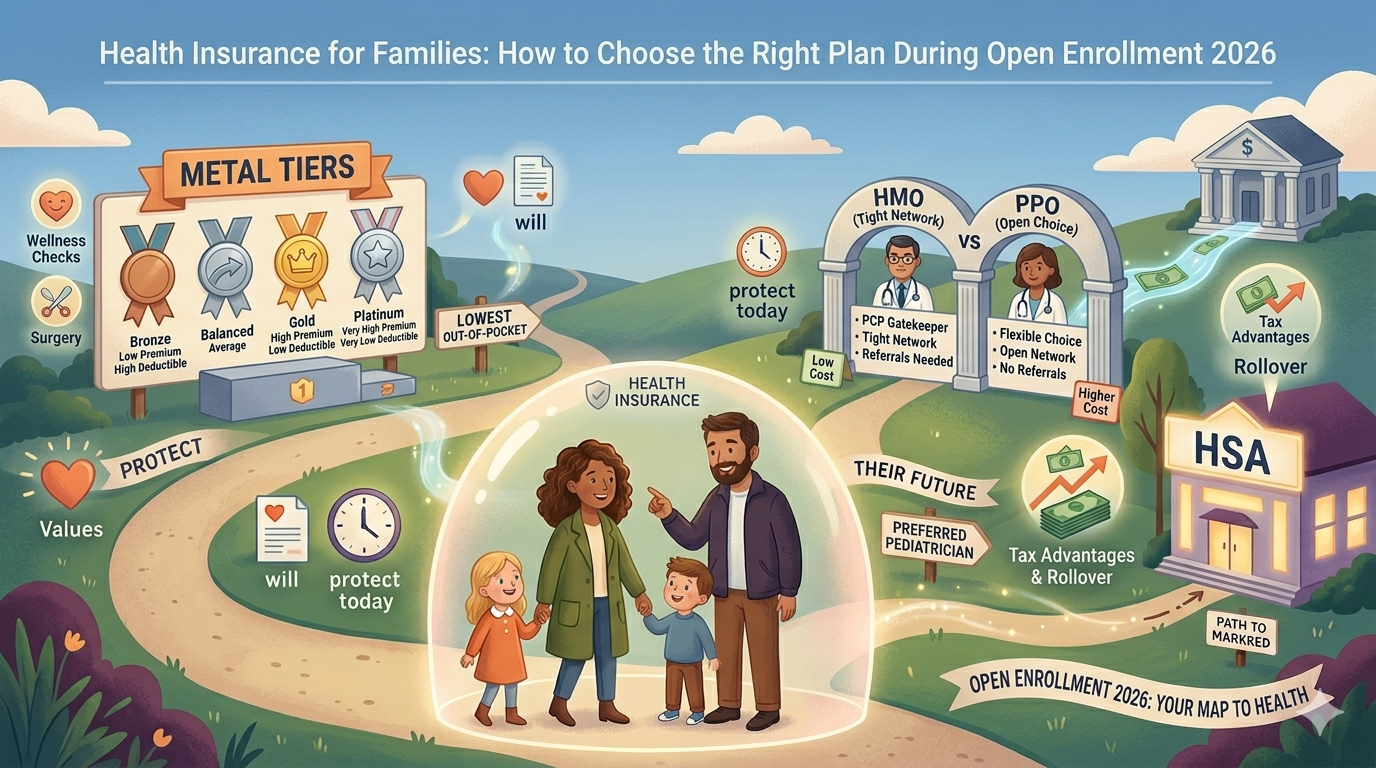
Health insurance plans are generally categorized into Bronze, Silver, Gold, and Platinum tiers. These levels don’t indicate the quality of care, but rather how you and the insurer split costs.
-
Bronze & Silver: Usually have lower monthly premiums but higher deductibles. These are ideal for “healthy” families who only see the doctor for wellness checks and the occasional ear infection.
-
Gold & Platinum: Higher monthly premiums with very low deductibles. If you have a child with a chronic condition like asthma, or if you are planning a surgery in 2026, these plans often save you money in the long run by capping your out-of-pocket expenses early in the year.
2. HMO vs. PPO: The Network Battle of 2026
In 2026, many insurers have narrowed their “Preferred Provider” lists to keep costs down. This makes checking your network status more critical than ever.
-
PPO (Preferred Provider Organization): Offers the most flexibility. You can see specialists without a referral and go out-of-network (though it costs more). If you have a favorite pediatrician or a specific specialist you refuse to leave, a PPO is usually the safest bet.
-
HMO (Health Maintenance Organization): Typically more affordable but much more restrictive. You must choose a Primary Care Physician (PCP) who acts as a “gatekeeper” for all referrals. If your child’s current doctor isn’t in the HMO’s tight network, you’ll be paying 100% of the bill yourself.
3. The Power of the HSA (Health Savings Account)
If you choose a High Deductible Health Plan (HDHP), you gain access to an HSA. In 2026, the tax advantages of these accounts are stronger than ever.
An HSA allows you to put aside pre-tax money to pay for qualified medical expenses—including braces, eyeglasses, and prescriptions. Unlike a Flexible Spending Account (FSA), the money in an HSA “rolls over” every year. For young families, this acts as a dual-purpose tool: a medical safety net today and an investment vehicle for the future.
4. Look Closely at “Value-Added” Benefits
2026 has seen a surge in “hidden” benefits that can save families hundreds of dollars. When comparing plans, look for:
-
Telehealth Integration: Does the plan offer 24/7 $0-copay virtual visits? This is a lifesaver for 10:00 PM fevers.
-
Mental Health Parity: Check the coverage for child therapy and counseling. With rising anxiety rates, ensure your plan has a robust list of behavioral health providers.
-
Pharmacy Tiers: If a family member takes regular medication, check the plan’s “formulary” (drug list) to see if that specific medicine is covered at a reasonable price.
5. Calculate Your “Total Cost of Ownership”
To find the real winner, don’t just look at the premium. Use this simple math:
(Monthly Premium x 12) + Expected Out-of-Pocket Costs = Your Real Price
A $300/month plan with a $6,000 deductible might actually be more expensive than a $500/month plan with a $500 deductible if your family visits the ER even once.
The Bottom Line
Open Enrollment for 2026 is your chance to audit your family’s health. Take an hour to look at your 2025 medical spending. Did you hit your deductible? Did you pay a lot for out-of-network care? Use that data to drive your decision.
Choosing the right plan isn’t about predicting every “what if”—it’s about ensuring that when a “what if” happens, your focus remains on your child’s recovery, not the hospital bill. Log in to your portal today and start the comparison; your future self will thank you.