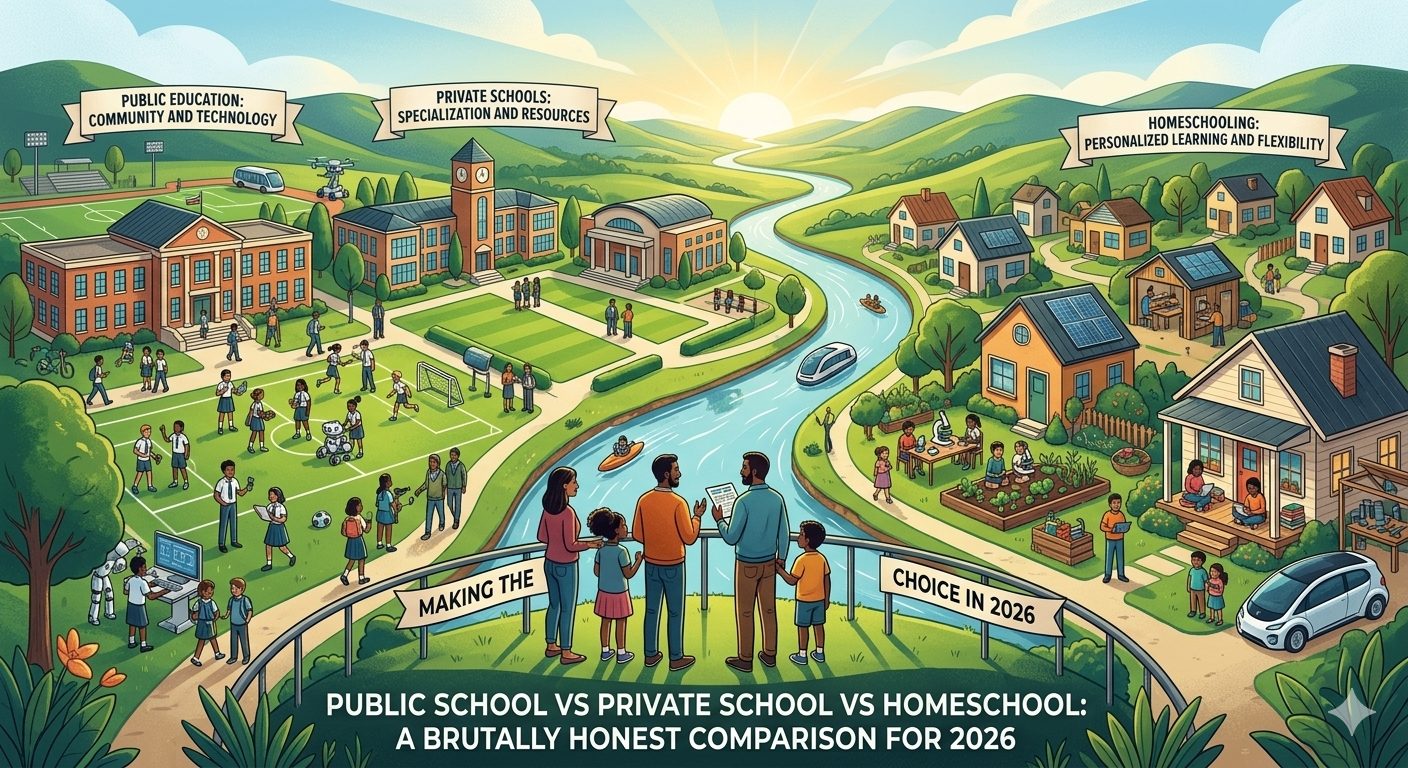
Every parent hits this crossroads eventually. You’re staring at a blank enrollment form, a tuition invoice, or a curriculum catalog — and suddenly the weight of “getting this right” lands square on your chest. The truth? There’s no universally correct answer. But there is a right answer for your child. Let’s cut through the noise.
The State of Education in 2026
The education landscape looks different than it did five years ago. Post-pandemic learning gaps, an AI-driven job market, and a growing mental health crisis among teenagers have forced parents everywhere to rethink what school should actually do for a child. Standardized scores, socialization, flexibility, cost — it all carries more weight than ever before.
So let’s get honest about all three options.
Public School: Free Doesn’t Mean Without Value
Public school remains the default choice for roughly 85% of American families, and there are genuinely good reasons for that. It’s free, locally accessible, and legally required to serve every child — including those with learning disabilities through IEP and 504 plans. The social exposure alone has real value: your child sits next to kids from different backgrounds, income levels, and life experiences. That’s not nothing. That’s preparation for the real world.
Strong public schools also offer a range of extracurriculars — sports, arts programs, debate teams, student government — that are hard to replicate elsewhere. Certified, specialized teachers and on-site counselors round out a support system that most families take for granted until it’s gone.
Here’s the part nobody loves to say out loud, though: classroom quality varies wildly by zip code. A well-funded suburban public school can outperform many private institutions. An underfunded school in a struggling district may leave gifted kids bored and struggling kids behind. Teacher shortages in 2025–2026 have made staffing inconsistencies a genuine problem across many regions.
If your local public school is strong, use it. Don’t pay for private school simply out of status anxiety.
Private School: Premium Price, Premium… Maybe
Private schools pitch themselves on prestige, values alignment, and superior outcomes. Some absolutely deliver on that promise. Others are gloriously expensive disappointments.
The genuine advantages are real. Smaller class sizes — often 15 to 18 students — mean more individual attention. Rigorous academic programs, stronger AP and IB pathways, and dedicated college counseling can make a meaningful difference for academically driven kids. If faith-based or values-aligned instruction matters to your family, private school may be the only setting that delivers it consistently.
But here’s the uncomfortable truth: tuition averages $15,000 to $35,000 per year in 2026, and financial aid is both limited and competitive. Research consistently shows that when you control for socioeconomic background, the academic performance gap between public and private school largely disappears. You’re often paying for peer networks and social signaling as much as you’re paying for educational quality.
Before you sign anything, ask the hard question: What specifically does this school offer that my child genuinely cannot get elsewhere? If you can answer that clearly, it may be worth every dollar. If you’re struggling to answer it, that tells you something important.
Homeschool: Maximum Freedom, Maximum Responsibility
Homeschooling has exploded in recent years. Roughly 3.3 million U.S. children were homeschooled in 2024, and the number continues to climb. In 2026, the tools available to homeschool families are genuinely impressive — AI-assisted tutoring platforms, local co-ops, online dual enrollment programs, and structured curricula give parents real options at every level.
The benefits are hard to argue with. Homeschooling allows fully customized pacing and learning styles. A child who’s two years ahead in math but needs extra time with reading can get exactly that, without the awkwardness of a traditional classroom. Families can travel, pursue deep interests, and build education around real life rather than forcing real life around a school calendar.
The honest challenges deserve equal airtime, though. Socialization requires deliberate, consistent effort — it doesn’t happen automatically when you’re not in a building with 300 other kids. Not every parent is equipped to confidently teach calculus, AP chemistry, or a second language. Homeschool parent burnout is real and underreported. And while college admissions have become increasingly homeschool-friendly, careful transcript documentation and extracurricular planning still demand significant time and attention.
The Verdict: Stop Looking for a Winner
The instinct to rank these options — to declare one “best” — is understandable, but it’s the wrong frame entirely. The best school is the one that fits your child’s specific learning style, your family’s actual values, and the life you’re genuinely living.
Visit the schools you’re considering. Have real conversations with homeschool families in your area. Look honestly at your schedule, your finances, and your child’s personality. Trust your gut — but back it up with research.
Because in 2026, the goal isn’t picking the most prestigious option on paper. It’s raising a kid who’s genuinely curious, capable of independent thought, and actually prepared for whatever comes next. Any of these three paths, done well, can get you there.