In an era of digital payments and “one-click” purchases, the concept of money has become increasingly abstract for children. Unlike previous generations who saw physical cash change hands, today’s kids see parents tap a phone or a card, and goods magically appear.
Teaching financial literacy is no longer just about the “piggy bank”—it’s about preparing your children for a world where financial decisions are constant and complex. Here is a guide to teaching money management, tailored to your child’s developmental stage.
Ages 3–5: The Concept of Exchange
At this age, children are just beginning to understand that things have value. The goal isn’t to explain interest rates, but to establish that money is a finite resource used to get things we want or need.
-
The Clear Jar Method: Instead of an opaque piggy bank, use a clear glass or plastic jar. Seeing the money physically grow creates a visual connection between saving and accumulation.
-
Play Store: Use play money to “buy” snacks or toys at home. It teaches them that to get something, you must give something up.
-
Wants vs. Needs: Start the conversation early. “We need milk for our cereal, but we want the chocolate cookies.”
Ages 6–10: The Three-Pillar System
Once a child enters elementary school, they can handle more responsibility. This is the ideal time to introduce a structured allowance or a commission-based system for chores.
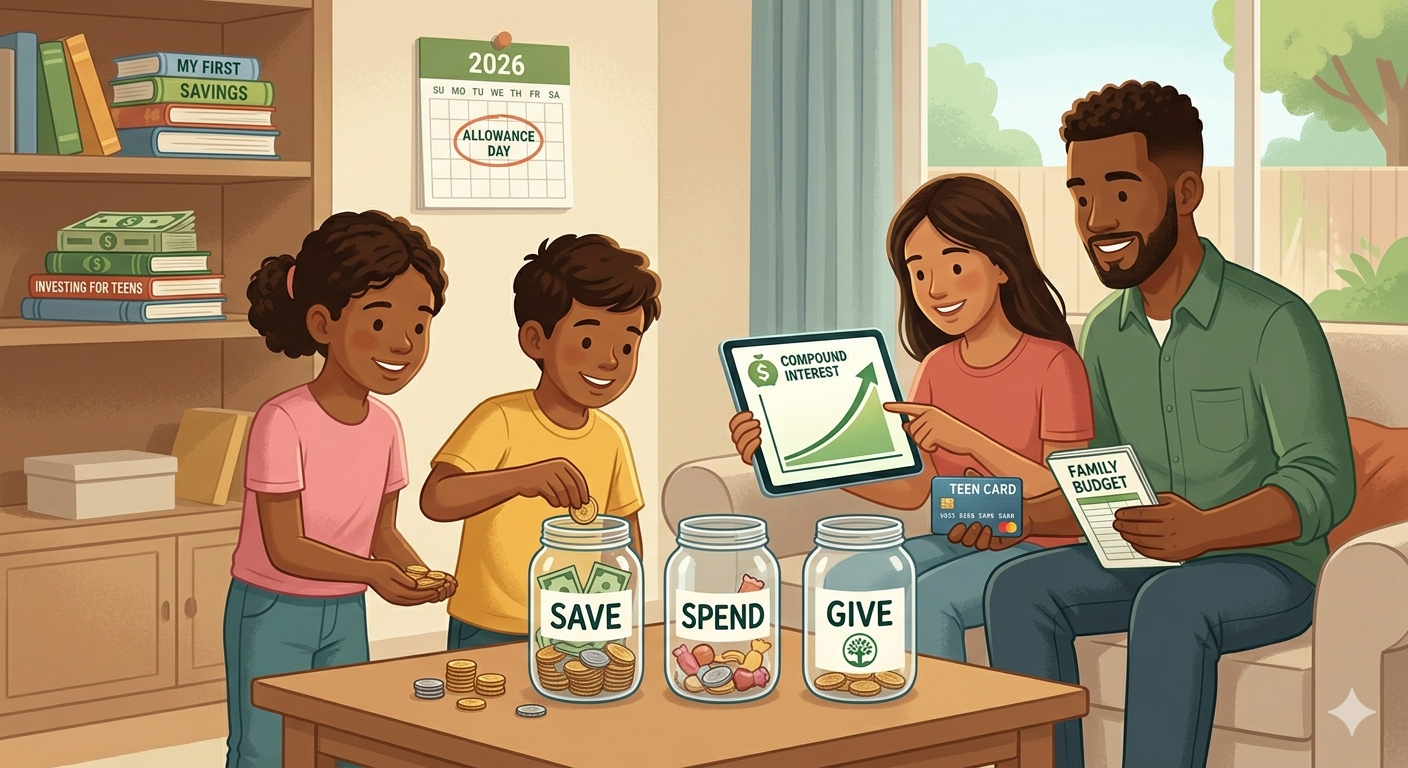
The Give, Save, Spend Approach
Introduce three separate jars or accounts to help them categorize their money. This teaches balance and the importance of looking beyond immediate gratification.
-
Spend: For small toys or treats they want now.
-
Save: For “big ticket” items (a specific LEGO set or video game).
-
Give: To a charity or cause of their choice, fostering empathy and social responsibility.
-
Opportunity Cost: If they spend all their “Spend” money on candy, they won’t have enough for a small toy later. Let them make these small mistakes now when the stakes are low.
Ages 11–13: The Digital Transition
As children enter their “tween” years, they move away from physical toys toward digital experiences (in-game purchases, apps, or outings with friends).
-
Open a Savings Account: Take them to the bank to open their first official account. Explain how the bank keeps their money safe and introduce the concept of compound interest—the idea that their money can “earn” its own money.
-
The “Wait-and-See” Rule: To curb impulsive digital spending, implement a 24-hour rule for any purchase over $15. Usually, the “must-have” feeling fades by morning.
Ages 14–18: Real-World Preparation
By high school, the focus shifts to independence and long-term planning. This is the “dry run” before they leave the nest.
-
Budgeting for Basics: Give them a set amount of money for a specific category, like clothing or school lunches. If they blow their budget on a designer jacket, they have to figure out how to manage the remaining weeks.
-
Introduction to Credit: Explain how credit cards work—emphasizing that they are loans, not “free money.” Discuss the importance of a credit score for their future (renting an apartment or buying a car).
-
The Power of Compound Interest: Show them a chart of how saving $50 a month starting at age 15 compares to starting at age 35. The visual of long-term growth is often the most powerful motivator.
Leading by Example
The most important lesson isn’t what you say, but what you do. Let your children see you comparing prices at the grocery store, discussing the family budget, or choosing to save for a vacation rather than buying something on impulse. By making money a transparent, healthy topic of conversation, you give your children the ultimate head start in life.