Let me guess: you’ve been meaning to open a 529 college savings plan for a while now.
Maybe since your child was born. Maybe since your last birthday made you do math you didn’t want to do. Maybe since a coworker mentioned theirs casually over lunch and you nodded like you already had one.
You don’t. And that’s okay. Because the truth about 529 plans is that most parents think they’re more complicated, more expensive, and more locked-down than they actually are — and that assumption is costing their kids real money every year they wait.
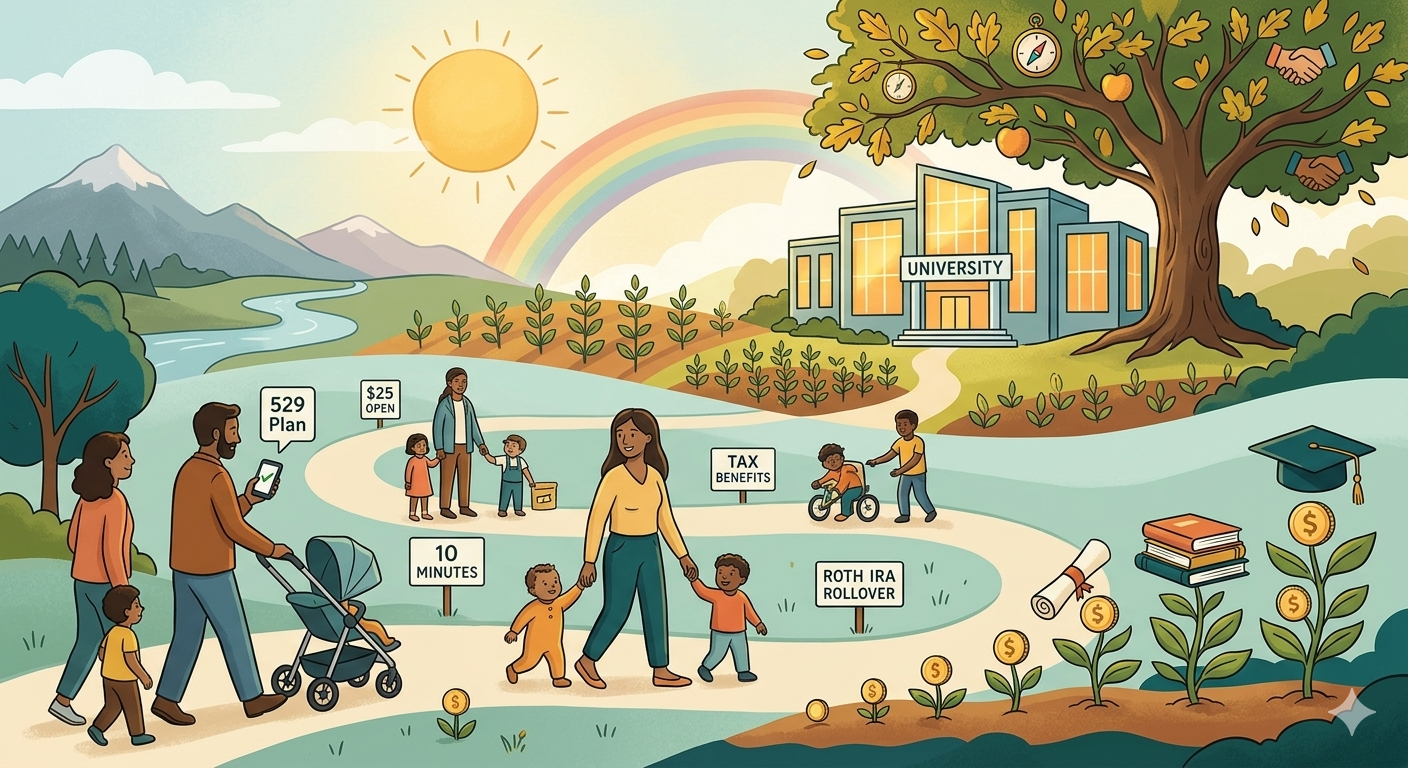
Here’s the reality: you can open a 529 college savings plan today, in about ten minutes, with as little as $25. No financial advisor required. No minimum income. No perfect financial situation needed first.
Let’s walk through exactly how.
What Is a 529 Plan, Actually?
A 529 plan is a tax-advantaged savings account specifically designed for education expenses. You deposit money, it grows invested (similar to a Roth IRA but for education), and when your child uses it for qualified education expenses — tuition, books, room and board, even K-12 tuition up to $10,000/year — the withdrawals are completely tax-free.
That last part is the one most parents underestimate. You’re not just saving money. You’re saving money that grows without being taxed on the gains. On a 15-to-18-year investment horizon starting when a child is young, that tax-free compounding can be worth tens of thousands of dollars compared to a regular savings account.
Every state offers at least one 529 plan. You don’t have to use your own state’s plan — and sometimes, you shouldn’t. More on that in a moment.
“But What If My Kid Doesn’t Go to College?”
This is the #1 reason parents hesitate, and it deserves a direct answer.
Starting in 2024, thanks to the SECURE 2.0 Act, unused 529 funds can be rolled over into a Roth IRA in your child’s name — up to $35,000 lifetime, subject to annual Roth contribution limits. That means even if your daughter decides to become a carpenter or your son launches a business straight out of high school, the money you saved doesn’t disappear. It becomes their retirement head start.
You can also change the beneficiary to another child, a sibling, a cousin, even yourself if you go back to school. A 529 is far more flexible than it used to be, and the “what if they don’t go?” fear is no longer a reason to delay.
Should You Use Your State’s 529 Plan?
Maybe. Here’s the quick test:
Use your state’s plan if: Your state offers a tax deduction or credit for contributions. About 35 states do. If you live in New York, for example, you can deduct up to $5,000 per year ($10,000 for married couples) on your state taxes. That’s an immediate return on your contribution that’s hard to beat.
Look at other states’ plans if: Your state offers no tax benefit (California, New Jersey, and a handful of others fall here), or if your state’s plan has high fees and limited investment options. In that case, plans like Utah’s my529, Nevada’s Vanguard 529, or New York’s Direct Plan are consistently rated among the best in the country for low fees and solid investment choices.
The bottom line: Google “[your state] 529 tax deduction” before you open anything. Five minutes of research here can save you hundreds of dollars a year.
How to Open a 529 Plan in 10 Minutes
No jargon. No overwhelming options. Just the actual steps.
Step 1: Choose Your Plan (2 minutes)
Go to savingforcollege.com — it’s the most reliable independent resource for comparing 529 plans. Use their plan comparison tool, filter by your state, and check whether your state offers a tax deduction. If it does, start there. If it doesn’t, sort by lowest fees.
For most parents reading this, the decision comes down to two or three options maximum. Don’t let perfect be the enemy of open.
Step 2: Go to the Plan’s Website and Click “Open an Account” (1 minute)
Every state 529 plan has a direct online enrollment option. You do not need to go through a broker or financial advisor. Going direct saves you from advisor fees (called “load” fees) that can quietly drain hundreds of dollars over time.
Step 3: Enter Your Information (3 minutes)
You’ll need:
- Your name, address, and Social Security number (you’re the account owner)
- Your child’s name, date of birth, and Social Security number (they’re the beneficiary)
- Your bank account and routing number for the initial deposit
That’s it. No income verification. No credit check. No financial history required.
Step 4: Choose Your Investment Option (2 minutes)
This is where most parents freeze. Don’t.
If your child is young (under 10), select the age-based portfolio — sometimes called a “target enrollment” fund — that matches the year your child will approximately start college. These portfolios automatically shift from aggressive (mostly stocks) when your child is young to conservative (mostly bonds) as college approaches. You set it once and never touch it.
If you want slightly more control, a simple two-fund option — a total stock market index fund and a bond fund — works well. But for most parents, the age-based option is the right default.
Step 5: Set Up Your Initial Deposit and Automatic Contributions (2 minutes)
Start with whatever you can. Many plans accept as little as $10 or $25 to open. The number is not the point right now — the account being open is the point.
Then, set up a recurring automatic contribution. Even $25 or $50 a month. Automation is the secret to actually building this account, because it removes the monthly decision and the monthly guilt.
$50/month starting at birth, growing at a historical average stock market return of roughly 7%, reaches approximately $19,000 by the time your child turns 18. Not a full ride. But a meaningful, tax-free head start that you built on $1.67 a day.
What Can the Money Be Used For?
Qualified 529 expenses include:
- College tuition and fees at any accredited U.S. or many international institutions
- Room and board (on or off campus, within cost-of-attendance limits)
- Textbooks and required supplies
- Computers and technology required for enrollment
- K-12 tuition up to $10,000/year
- Apprenticeship programs registered with the U.S. Department of Labor
- Student loan repayment up to $10,000 lifetime per beneficiary
The list has expanded significantly in recent years. What it doesn’t cover: transportation, health insurance, and general living expenses not tied to enrollment.
The Cost of Waiting One Year
Parents often say they’ll open a 529 “when things settle down” or “when we have more to put in.” It’s worth understanding what that delay actually costs.
If you invest $100/month starting when your child is born versus starting when they turn five, the difference at age 18 — assuming 7% average annual growth — is roughly $14,000. That’s the price of waiting five years, even though you contributed the same $100/month.
Time is the most powerful force in investment growth. A small account opened today outperforms a larger account opened in three years. Every month the account doesn’t exist is a month of compounding your child doesn’t get back.
Common 529 Questions, Answered Quickly
Can grandparents contribute? Yes. Anyone can contribute to a 529 plan. Grandparent contributions used to affect financial aid calculations, but under new FAFSA rules effective 2024, grandparent-owned 529s no longer impact federal aid eligibility.
Is there a contribution limit? There’s no annual contribution limit per se, but contributions above $18,000/year (2024 gift tax exclusion) per donor may trigger gift tax reporting. Total account balances are capped by state, typically between $300,000 and $550,000.
What if I open the wrong plan? You can do a penalty-free rollover to a different 529 plan once every 12 months. You’re not locked in.
Do I need a financial advisor? No. Direct-sold plans are designed for self-enrollment. An advisor can help with broader financial planning, but for the 529 itself, going direct costs you nothing extra and saves you the advisor fee layer.
Just Open It Today
The best 529 plan is not the one with the perfect investment allocation or the maximum first contribution. It’s the one that exists.
Ten minutes. Your Social Security number. Your child’s birthday. A bank account number. And $25 you probably won’t miss.
Open it tonight, before you close this tab, before the week gets away from you, before another year passes with this still on the list.
Your future self — and your kid — will thank you.