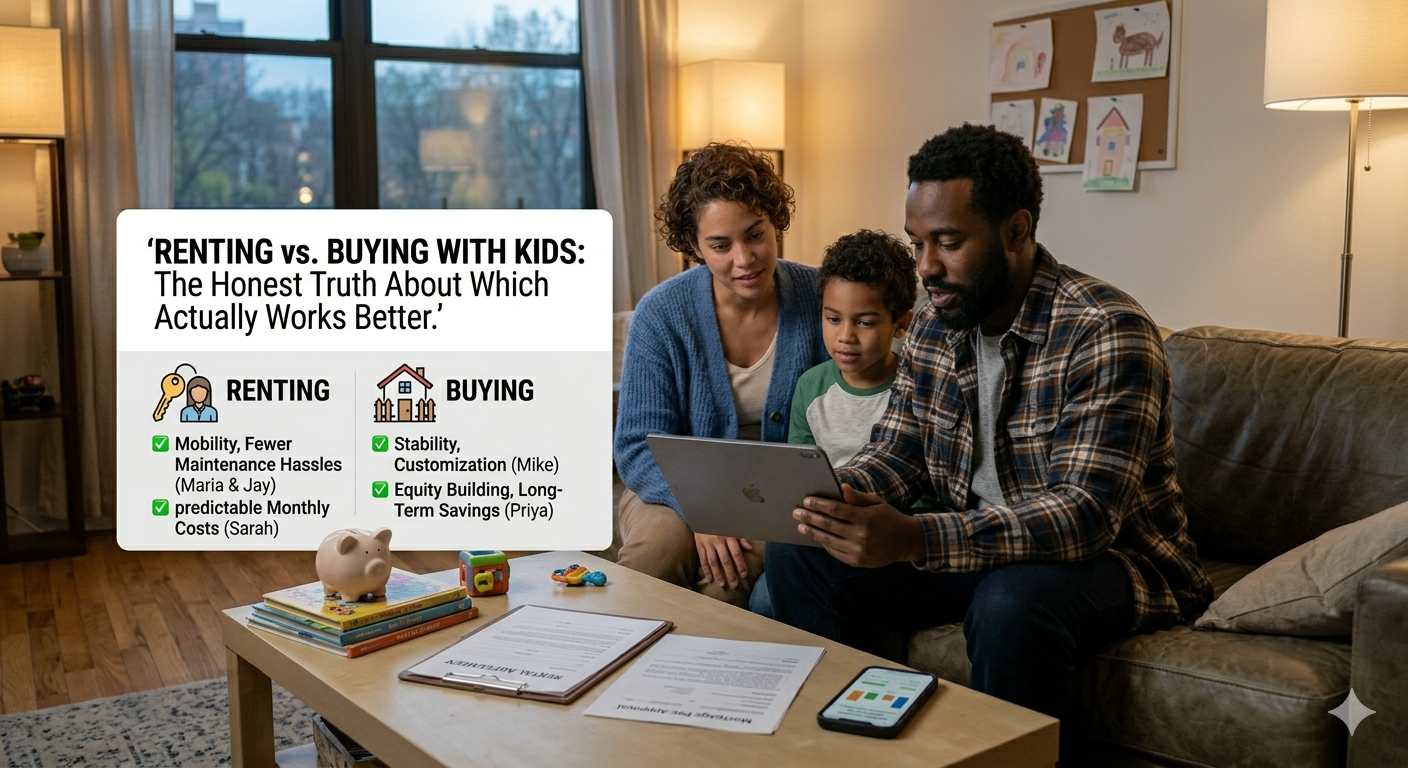
Few financial decisions feel more loaded for parents than the rent-versus-buy question. There’s a deeply embedded cultural script that says responsible parents own their home — that a mortgage represents stability, roots, and a legacy worth leaving. But in 2026, that script deserves a hard re-examination. The honest answer isn’t a simple one, and it depends far more on your specific circumstances than any blanket rule about what “real” families do.
The Case for Buying: It’s More Than Just Equity
Homeownership does offer real, concrete advantages for families. The most obvious is predictability. A fixed-rate mortgage means your housing cost stays the same for decades. Renters in competitive markets have experienced sharp, sudden rent increases that upended school enrollments, disrupted friendships, and forced families to relocate on short notice. With a mortgage, that particular unpredictability disappears.
There’s also the equity argument. Every mortgage payment builds ownership in an asset that, in most markets over time, appreciates. Rent payments build nothing you can pass on or borrow against. For parents thinking about long-term financial security — a college fund, retirement, an inheritance — the home often becomes the most valuable asset they own.
Stability for children is another real factor. Research consistently shows that residential stability correlates with better school performance and stronger social development. Staying in one district, one neighborhood, one friendship group matters, and homeownership tends to make that continuity more achievable.
The Case for Renting: The Math Is Messier Than You Think
Here’s what the pro-buying narrative skips over: the full cost of owning a home is significantly higher than the mortgage payment. Property taxes, homeowner’s insurance, maintenance, repairs, HOA fees where applicable, and the opportunity cost of a large down payment all add up. Financial analysts frequently point out that when all costs are factored in, renting and investing the difference can outperform homeownership in many markets — particularly expensive urban ones.
Flexibility is renting’s most underrated advantage. Families whose careers are still evolving, who may need to relocate for opportunity, or who are unsure whether their current city is a long-term fit are genuinely better served by renting. Buying in the wrong location or at the wrong life stage is expensive to undo. Transaction costs alone — agent commissions, closing costs, moving expenses — typically require five to seven years of ownership before buying breaks even over renting.
For families in high cost-of-living areas, renting also means access to neighborhoods and school districts that would be financially impossible to buy into. That can mean better schools, shorter commutes, and a higher quality of daily life — all things that matter for children.
The Question Nobody Asks Enough: What’s Your Timeline?
The single biggest variable in this decision isn’t the market or interest rates — it’s how long you plan to stay. The five-year rule of thumb holds up well: if there’s a realistic chance you’ll move within five years, renting almost always makes more financial sense. If you’re confident about a decade or more in one place, buying begins to pay off in ways renting cannot match.
With kids in the picture, that timeline question gets sharper. Many parents anchor around school years — committing to a district until the youngest graduates high school. That’s a twelve-to-fifteen year horizon for some families, which is more than enough time for homeownership to make financial sense in most markets.
The Honest Bottom Line
Neither path is inherently superior. The parent who rents a well-located home in a great school district while keeping their finances flexible isn’t making a lesser choice than the one who buys. What matters is that the decision is made deliberately, with clear eyes about the true costs, your career trajectory, your target timeline, and what stability actually looks like for your specific family.
The worst version of this decision is the one made out of social pressure rather than honest calculation. Own that choice — whichever one it is.