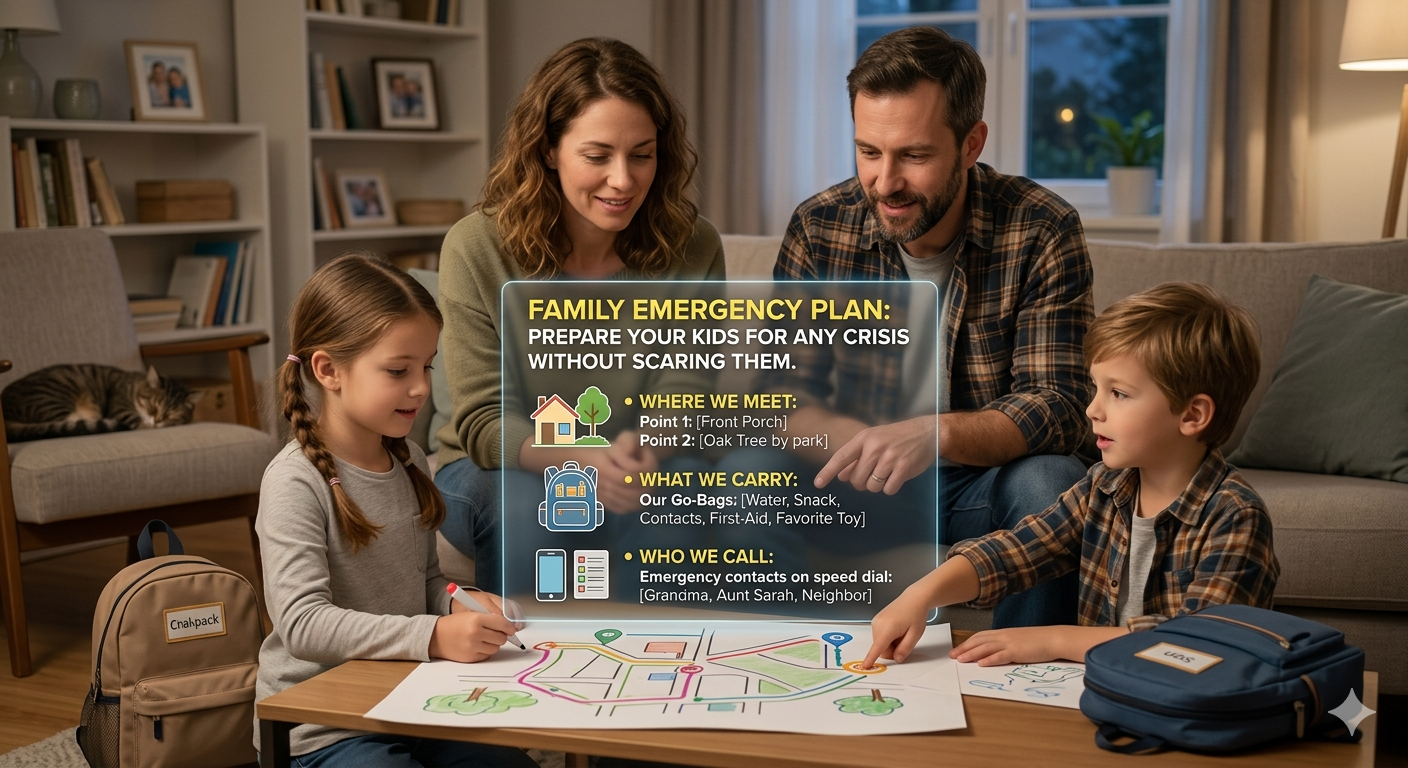
Nobody wants to sit their child down and talk about earthquakes, fires, or family separations. It feels like handing them a worry they weren’t carrying before. But here’s the truth experienced emergency responders and child psychologists both agree on: preparation doesn’t create fear — it reduces it. Children feel safer when they know what to do. The goal isn’t to shield them from the reality that emergencies happen. It’s to make sure they’re never left helpless if one does.
Lead With Confidence, Not Catastrophe
The way you introduce the conversation shapes everything. There’s a significant difference between “We need to talk about what happens if our house burns down” and “Let’s make a family game plan so we always know how to find each other.” Same information. Completely different emotional register.
Frame preparedness as something strong, capable families do — like wearing a seatbelt or keeping a first aid kit. You’re not preparing for disaster; you’re practicing being a team. Kids take emotional cues from parents, so if you approach the conversation calmly and practically, they will too.
Give Every Child a Job
Children feel anxious when they’re passive. Give them an active role in the family plan, and anxiety transforms into confidence. Even a five-year-old can memorize a phone number or know which neighbor’s house is the meeting point. Older kids can be responsible for grabbing the go-bag, helping a younger sibling, or knowing how to call emergency services.
When a child has a specific responsibility, they shift from “something scary might happen to me” to “I know what I do when this happens.” That mental shift is enormously protective. Practice it together. Run a casual fire drill on a Saturday morning. Make it matter-of-fact rather than dramatic.
Build the Plan Around Simple, Repeatable Information
An effective family emergency plan doesn’t need to be complicated. It needs to be memorable. Focus on three core pillars:
Meeting points. Identify two: one just outside your home (the front yard, a specific tree) and one farther away (a neighbor’s house, a local landmark) in case the immediate area is unsafe. Walk your kids to both locations so they’re concrete, not abstract.
A contact person. Choose a trusted adult outside your immediate household — a grandparent, aunt, family friend — who everyone knows to call or go to if you can’t reach each other. Long-distance contacts are often easier to reach during local emergencies when local lines are overwhelmed.
Key information by heart. Every child old enough to speak should know their full name, a parent’s phone number, and their home address. For younger children, a small card tucked into a backpack works as a backup. For older kids, make sure they know how to send a location pin or use emergency SOS on their phone.
Revisit It Without Making It a Big Event
One conversation isn’t enough — but that doesn’t mean monthly drills and laminated checklists on the refrigerator. Weave check-ins into everyday moments. After watching a news story about a storm: “Remember what we do if we ever need to leave the house quickly?” After a power outage: “Good job staying calm — what would you do if I wasn’t home when that happened?”
Normalization is the goal. Emergencies become less frightening when children have already walked through the steps in their minds dozens of times in low-stakes moments.
The Biggest Gift You Can Give
Preparedness is an act of love, not fear. When your child knows the plan, knows their role, and trusts that the adults around them have thought ahead, they carry a quiet confidence into the world. You’re not teaching them that the world is dangerous. You’re teaching them that no matter what happens, your family knows how to find each other.
That’s not a scary conversation. That’s one of the most reassuring ones you’ll ever have.